
Garden Lighting Ideas from the UK’s Best Designers: What Chelsea and Thirty Years of Design Thinking Teach Us About Lighting Your Garden

Updated: Oct 15

There is a particular moment on an autumn evening in Sussex when the light goes. One minute the garden is there, the lawn and the borders and the old apple tree by the fence; the next it has vanished, and all you can see from the kitchen is your own reflection in the glass. For many of us that moment arrives before five o’clock for almost half the year. It is the reason so many people start searching for garden lighting ideas, and it is the reason we do what we do.
This article is our attempt to gather the best outdoor lighting ideas we know in one place. Some of them come from the gardens at the RHS Chelsea Flower Show, where the country’s finest landscape and lighting designers show what is possible. Some come from the published thinking of respected UK lighting studios, and from the design principles that professional lighting designers have refined over three decades. And some come from our own experience of lighting gardens across Sussex, Surrey, Kent and South West London, from Victorian terraces in Hove to flint-walled cottages on the edge of the Downs.
Our aim is simple. We would like to translate show garden ideas into real back gardens, gently, so that you finish reading with a clearer sense of what your own garden could feel like after dark and how to get there. We will look at trees, paths, patios, garden rooms, water, small courtyards, sloping plots and more, and we will talk honestly about the practical side too: controls, safety, neighbours and the wildlife that shares our gardens at night.

Why the best garden lighting ideas start with an idea, not a product
Most people begin with a product. They see a pretty lantern in a catalogue, or a set of solar spikes on offer, or a string of festoon lights at a friend’s barbecue, and they wonder where it might go. There is nothing wrong with that, and some lovely gardens have grown from a single well-chosen lamp. But the gardens that truly move us at night almost always begin somewhere else. They begin with an idea about how the garden should feel.
That idea might be as simple as “I would like to see the birch tree from the sofa in winter.” It might be “I want the path to the studio to feel safe but not like a runway.” It might be “we eat outside all summer, and when the sun goes down the table feels marooned.” Each of these is a genuine garden lighting idea, and each one tells a designer far more than a product ever could. It points to a view, a use, a mood and a time of year.
The view from inside comes first
For much of the year in the UK, the garden at night is something we look at rather than something we sit in. We see it from the kitchen, the sitting room, the landing window on the way to bed. So the first question we ask on any design visit is where you actually stand and sit in the evening, and what you would love to see from there. A beautifully lit tree that can only be seen from the far end of the lawn is a missed opportunity. The same tree framed by the kitchen doors becomes a living picture that changes with the seasons.
This is also why we always encourage people to think about reflections. Once it is dark outside, a large pane of glass behaves a little like a mirror. A few carefully placed points of light in the garden balance the brightness either side of the glass, so that the window becomes a view again rather than a black screen. It is one of the most transformative outdoor garden lighting ideas we know, and it costs nothing more than good placement.
“Nearly every client I meet in Brighton and Hove has the same story: big new glass doors at the back of the house, and a garden that disappears the moment the sun goes down. We start by standing at those doors together as it gets dark, and it becomes obvious very quickly which two or three things are worth lighting. It is rarely the things people expect.”
Light what matters, leave the rest dark
The second part of the idea is restraint. Our own philosophy, which you will see woven through this whole article, is to light what matters and leave the rest dark. A garden at night is not a smaller, dimmer version of the garden by day. It is a different place, with its own shape and atmosphere, and it is defined as much by what you choose not to light as by what you do. We have written a separate piece about this, “Designing with darkness: what a garden lighting scheme should leave unlit”, which is a lovely companion read if this way of thinking appeals to you.
Ideas that last
Finally, an idea outlasts a product. Fashions in fittings come and go (we will look at the current ones later), but the reasons a lit tree feels magical, or a softly lit step feels reassuring, have not changed in decades. If you build your scheme around those reasons, you can swap a lantern or refresh a finish years from now without starting again. That is the heart of design-led lighting, and it is what the rest of this article is about.
What the UK’s garden lighting designers agree on
Talk to enough professional garden lighting designers and a quiet consensus emerges. The language varies, the fittings vary and every studio has its own signature, but the underlying principles are remarkably consistent. John Cullen Lighting, one of the most respected names in British residential lighting and the studio behind many Chelsea show gardens, sets out a clear framework in its published garden lighting guide [6], and it aligns closely with what we practise ourselves and with guidance from bodies such as the RHS [13] and DarkSky International [12]. These are the ideas that most good designers would sign up to.
Layering: ambient, accent and task
The first shared principle is layering. Rather than one bright source trying to do everything, a well-designed garden uses several gentle layers that work together. John Cullen describes three: ambient light that gives a general sense of the space, accent light that picks out features such as trees, sculpture or a lovely wall, and task light for practical jobs like cooking, reading or finding the back gate [6]. Lighting commentators looking ahead to 2026 have made the same point, describing a move towards gentle layering rather than one bright source [8].
In practice, layering is what gives a garden depth at night. A softly lit foreground terrace, a glowing tree in the middle distance and a faint wash on the far boundary together create three planes, and the eye reads that as space. Take any one of those layers away and the garden flattens.
Light vertical surfaces to make a garden feel larger
The second principle may be the single most useful of all our garden lighting ideas. Light the vertical surfaces. Trees, hedges, walls and fences are what the eye reads as the edges of a space, and lighting them makes the garden feel larger and more enclosed at the same time [6]. Lighting the ground alone, by contrast, tends to create isolated puddles of brightness that leave the edges of the garden in darkness and make it feel smaller than it is.
This is especially powerful in narrow town gardens, where a gentle wash on the rear wall or a softly uplit tree at the far end pulls the eye through the whole plot. It is also why flint and brick boundary walls, which are so common across Sussex, make such wonderful canvases at night. Their texture comes alive under grazing light.
See the effect, not the source
The third principle is about glare. Good garden lighting lets you see the effect of the light (the glow on a leaf, the pool on a path, the texture of a wall) without seeing the bright point it comes from. John Cullen puts it simply: low glare, see the effect not the source [6]. When you can see the lamp itself, your eye adjusts to that brightness and everything around it seems darker. When the source is hidden, even very low light levels feel generous and restful.
Glare control is achieved in several ways: by choosing fittings with deep recesses, cowls or honeycomb louvres; by aiming carefully so that no beam points at a seat or a window; by tucking fittings into planting; and by using much less light than most people expect. The DarkSky principles of targeted and low-level lighting [12] arrive at the same place from a different direction.
Darkness is a material
The fourth principle surprises people. Darkness is part of the design. John Cullen’s guide notes that “darkness is just as important as light” [6], and the RHS advice on lighting gardens for wildlife begins by suggesting we light as little as possible [13]. Shadow gives a garden mystery and depth. It lets the lit features stand out. It gives the eye somewhere to rest. And it is kinder to the bats, moths and birds that use our gardens at night.
Warm white, around 2700K
The fifth principle concerns colour temperature, which is measured in kelvin. The lower the number, the warmer and more amber the light. Very warm, candle-like light sits at roughly 2200K to 2400K, a traditional warm white lamp at around 2700K, soft white at 3000K and cool, bluish white at 4000K and above. John Cullen recommends 2700K for residential gardens and 2400K or lower for intimate areas such as dining terraces [6], and warm-coloured light is one of the five DarkSky principles for responsible lighting [12]. The RHS also recommends warm orange and yellow tones for wildlife [13].
We use 2700K as our starting point for almost every scheme, dropping a little lower for seating areas and occasionally going slightly cooler for the silver foliage of an olive or a birch, where a touch more crispness can be beautiful. What we avoid is the cold, blue-white light of many cheap fittings, which flattens planting and makes a garden feel like a car park.
Colour rendering matters too
Alongside colour temperature sits colour rendering, measured by CRI. A higher CRI means colours look more natural under the light. John Cullen recommends a CRI of 90 or above for gardens [6], and we agree. Under a good light, a copper beech looks like copper and a lavender border keeps its purple. Under a poor one, both turn a muddy grey.
Hidden fittings and gentle control
The final shared principle is that fittings should, wherever possible, be hidden or at least discreet, and that the light should be controllable. John Cullen’s guide highlights dimming and zoning so that a garden can be adjusted for different moods and uses [6], and its 2025 trends report points to minimalist architectural lighting with recessed and hidden LED sources, alongside smart adaptive systems [7]. We will return to controls later, because they are where a good scheme becomes a lovely one to live with.
“The test I use is simple. If a guest walks into the garden at night and says ‘what a beautiful tree’, we have done our job. If they say ‘what lovely lights’, we have probably put too many in, or put them in the wrong place.”
Lessons from Chelsea: show garden ideas for real back gardens
Every May, the RHS Chelsea Flower Show offers a glimpse of where British garden design is heading. The show gardens are built in a matter of weeks, judged in daylight and seen by most visitors in the middle of the day, so lighting is not always the first thing people notice. Yet the designers and lighting studios involved put enormous care into how these gardens behave as the light fades, and many of their ideas translate beautifully into ordinary back gardens. Here are the lessons we find most useful, drawn from the gardens and stands of 2023, 2024, 2025 and 2026.
Low-level lighting that disappears by day
In its round-up of take-home design trends from Chelsea 2024, the RHS singled out low-level lighting as one of seven ideas worth borrowing: soft, unobtrusive light that makes paths and steps safer to use after dark [1]. The detail that caught our eye was on the Boodles National Gallery Garden, where the light fittings were painted to match the surrounding planting so that they all but vanished during the day [1].
It is such a simple idea, and so often overlooked at home. A garden is seen by day far more than by night, particularly in summer, and a row of shiny stainless steel spikes along a border can undermine even the most beautiful planting. Choosing fittings in finishes that sink into their setting (dark bronze among shrubs, deep green in foliage, a stone tone against gravel) means the garden looks like a garden in daylight and only reveals its lighting after dusk. John Cullen Lighting took a similar approach on its Chelsea 2024 work, specifying fittings in olive green so that they would hide in the planting [3].
For a real garden, this lesson has a second half. Fittings that disappear still need to be reachable for aiming and maintenance, and planting grows. We place spike lights so that they can be nudged forward or back as a shrub fills out, and we keep a simple plan of every fitting so that nothing is lost when the borders are replanted.
Mixed materials, and how light reads on each one
Another 2024 trend was the confident mixing of hard landscaping materials. The RHS highlighted the Octavia Hill Garden by Ann-Marie Powell, which combined warm York stone pavers, vermillion clay setts and fine gravel [1]. By day, that mix creates rhythm and warmth. By night, each material responds to light in its own way, and understanding those differences is one of the quieter garden lighting ideas that makes a real difference.
York stone and other natural sandstones have a gentle texture and a warm, buff colour that takes warm light very kindly. A low, glancing light across a York stone terrace brings out the riven surface and makes the whole area feel soft and inviting. Clay setts and bricks absorb more light and read richer and darker, so they need a touch more intensity or a slightly closer fitting to hold their colour, and they are lovely with a very warm lamp that deepens their red and orange tones. Fine gravel scatters light in every direction, which means a pool of light on gravel looks broader and softer than the same light on stone, but it also means that very bright fittings can create a glary patch that draws the eye away from everything else.
Smooth porcelain, which is now common on new patios across the South East, is different again. It can reflect a surprising amount of light and, if a fitting is poorly aimed, you may see a bright reflection of the source in the paving. We tend to light porcelain terraces from the side or from above, with the fitting well shielded, rather than setting bright uplights directly into the surface.
Water at Chelsea 2025, and lighting water without lighting the pond
Water ran through the 2025 show in all sorts of inventive forms. The RHS noted the Hospitalfield Arts Garden, where water from a roof ran across clay pavers into a dipping pool; the Addleshaw Goddard Freedom to Flourish Garden, with a stepping grid through shallow water; spiral rain chains on the SongBird Survival Garden; and rain chains feeding circular rills on the Boodles Raindance Garden [2]. The year before, the RHS had highlighted water capture ideas on the WaterAid Garden and the Flood Resilient Garden, the latter with galvanised tanks and rain chains [1].
For lighting, these features are a gift, because moving water catches light beautifully. A rain chain lit gently from below or from the side becomes a column of glittering drops in a storm. A narrow rill catches a thin line of reflected light along its length. A dipping pool or still water trough reflects whatever is lit around it, doubling a tree or a wall in its surface. John Cullen’s work at Chelsea has regularly included water, with backlighting on water features in 2023 [4] and water feature lighting for drama in 2024 [3].
What we would gently caution against is lighting ponds themselves from within. The RHS advises against lighting ponds because of the effect on insects and the wildlife that feed on them [13]. The lovely thing is that you rarely need to. Light the plants and structures around the water, and let the water reflect them. You get the shimmer and the doubling without flooding the water column with light. For formal features such as rills, troughs and bowls, where there is no pond life to disturb, a small, well-shielded underwater or edge fitting can be lovely, but even here less is more.
Earth walls, gabions and willow screens as surfaces for grazing light
Chelsea 2025 was a year of textured walls. The RHS noted rammed earth walls in warm terracotta tones on the Hospice UK Garden of Compassion, the Garden of the Future and the Killik and Co Save for a Rainy Day Garden, gabion walls filled with reused brick, stone and straw, and horizontal willow screens on The Pathway Garden [2]. In 2024, strategic walls of dusky yellow stone had also caught the eye [1].
Every one of these surfaces is crying out for grazing light. Grazing means placing a fitting very close to the base of a wall and aiming it almost straight up, so the light skims across the surface. Every bump, layer and gap throws a small shadow, and the texture leaps out. Rammed earth, with its horizontal bands of colour, looks extraordinary grazed. So do gabions, where the light catches the edges of each stone or brick and leaves the gaps deep and dark. A willow screen grazed from below becomes a soft, woven glow.
At home, you do not need a rammed earth wall to use this idea. Sussex is full of beautiful textured boundaries: knapped flint, old red brick, clunch, weathered oak cladding and dry stone. A gentle graze along even a short stretch of a flint wall can become the defining image of a garden at night.
“Flint walls are one of the great joys of lighting gardens round here. Lit flat on, they can look a bit grey and busy. Grazed from a few centimetres away with a warm, narrow beam, every flint catches the light and the whole wall starts to sparkle. It is one of the first things I look for on a site visit.
Hideaways and shelters
The RHS also picked out shelters and hideaways as a theme at Chelsea 2025 [2], alongside creative seating in 2024 [1]. These are the places that pull you down the garden, and lighting is what makes them usable and inviting after dark. A small shelter at the end of a garden, lit from within with a warm, low glow, becomes a destination: a place to take a glass of wine on a September evening, or simply a lantern-like shape at the end of the view from the house. The key is warmth and softness. A single bright bulb in a shelter can feel like a bus stop. A hidden strip under a bench, or a low wall light washing down onto a table, feels like a retreat.
Multi-stem trees and the treehouse garden
John Cullen Lighting lit the Blue Forest Garden by Randle Siddeley at both the 2023 and 2024 shows, a garden built around a treehouse [3][4]. In 2023 the studio used spotlights on the house frame and planting, along with low-level path and foliage lights [4]. In 2024 the techniques included uplighting multi-stem trees, washing the treehouse frame and using discreet spike lights within the foliage, which the studio describes as providing “a soft glow” [3]. On the David Harber stand in 2023, cross-lighting of trees and canopy planting featured alongside uplights on timber structures [4].
Multi-stem trees are among the most popular choices in modern UK gardens, and for good reason: they are sculptural, they suit small plots and they look superb lit from below. Each stem catches the light separately, so the tree reads as a cluster of pale columns rising into a glowing canopy. We will go into tree lighting in more detail shortly, but the Chelsea lesson is that multi-stems reward care. Light one side only and the tree can look flat. Light it from two angles and it becomes three-dimensional.
The treehouse is a lovely reminder, too, that timber structures glow under warm light. Pergolas, oak-framed garden rooms, arbours and even a well-made shed can become part of the night-time composition with a gentle wash.
Sculpture lighting from the David Harber pieces
David Harber’s sculptures have appeared on Chelsea stands lit by John Cullen for several years. In 2023 the stand, designed by James Doyle Design Associates, featured the new sculpture Florio, with gilded copper flutes that gave off a warm glow as a celebration of pollination [4]. In 2024 the stand was designed by Jamie Langlands of Oxford Garden Design, with accent light on timber beams and downward path lighting [3]. And in 2025 the studio lit the Torus sculpture [5].
John Cullen’s account of lighting sculpture at Chelsea offers some of the clearest advice we know [5]. Narrow uplights pick out contours and edges, while a wide wash gives a softer, more general glow. Stone and ceramic absorb light, so they can be lit directly. Polished metal reflects light, so rather than aiming at the shiny surface (which simply bounces a bright reflection back at you) it is often better to light the surroundings and let the sculpture reflect them. For tight plots, ground-recessed uplights and spike lights offer flexibility [5]. The studio sums up the work as requiring “precision and sensitivity” [5], and we think that is exactly right.
For a garden with a special piece, whether a bronze hare, a stone bowl or a mirrored sphere, this is the lesson to take home. Think about the material before you think about the fitting.
The 2026 orangery stand and a nod to controls
At Chelsea 2026, one of the stands that caught the attention of Elle Decoration was a Soho Lighting stand by Sean Symington and Henry Agg, inspired by a Victorian orangery and featuring kinetic, battery-free switches [11]. It is a small detail, but it points to something important. The way we switch and control garden lighting is changing, and the best new systems are designed to be both beautiful and effortless. Whether it is a kinetic wall switch, a wireless keypad by the back door or a scene on your phone, control is part of the design, not an afterthought. We come back to this in the section on outdoor smart lighting.
The orangery reference is also a gentle reminder of how many Sussex homes have glazed garden rooms, conservatories and orangeries of their own. Lighting the garden beyond that glass is what makes those rooms feel open in winter rather than boxed in.

Outdoor tree lighting ideas
If you only light one thing in your garden, light a tree. Trees are the largest living structures most of us have, they change through every season, and they respond to light more generously than almost anything else. Outdoor tree lighting is also where the difference between a considered scheme and a scattering of spikes is most obvious. Here are the techniques we use most, and the trees that take light best.
Uplighting
Uplighting is the most familiar technique: a fitting at the base of the tree aimed upwards into the trunk and canopy. It is dramatic, sculptural and works well on trees with interesting bark or an open branch structure. The skill lies in the detail. A narrow beam close to the trunk emphasises the bark and the rise of the stem. A wider beam set further out lights more of the canopy. Two or three fittings at different angles give the tree depth.
As a rough guide, a small tree might need an uplight of around 200 to 400 lumens, while a large, mature canopy might need 400 to 800 lumens spread across more than one fitting. These are starting points rather than rules; a pale birch against a dark hedge needs far less light than a dark yew against an open sky.
It is worth saying that the RHS notes a risk to night-flying wildlife from uplighting trees [13]. We take that seriously. We keep uplighting to a small number of chosen trees, keep the levels low, use warm colour temperatures, aim the light into the tree rather than past it into the sky, and put decorative lighting on timers so it switches off later in the evening. We also avoid lighting any tree where we suspect bats may be roosting, which we discuss later.
Moonlighting
Moonlighting is the most magical of all outdoor tree lighting ideas, and one of the least used in domestic gardens. Instead of lighting up into the tree, a small fitting is mounted high in the canopy and aimed downwards through the branches. The light filters through the leaves and casts dappled, moving shadows on the lawn or terrace below, just like moonlight.
Moonlighting is wonderful above a seating area, over a lawn or across a path, and it has the added benefit that the fittings are almost invisible from the ground and the light is directed downwards. It needs a mature tree with a strong enough branch structure, careful fixing that will not harm the tree as it grows, and periodic checks. When it works, there is nothing quite like it.
“Moonlighting is the technique people ask about most once they have seen it. Put a small fitting high in a mature oak over a patch of lawn, and on a breezy night the shadows of the leaves drift across the grass. Clients tell me they switch it on just to watch it from the kitchen window.”
Cross-lighting
Cross-lighting means lighting a tree from two or more directions, usually from fittings set some distance apart. It gives a much more three-dimensional result than a single uplight, because each side of the trunk and canopy receives light and the shadows fall inwards rather than all in one direction. John Cullen used cross-lighting on trees in its 2023 Chelsea work [4] and lists it among its core garden techniques [6].
Cross-lighting is particularly helpful for trees that are seen from more than one place, such as a specimen tree in the middle of a lawn that you see from the house, the terrace and the garden room.
Silhouetting and shadow play
Sometimes the most beautiful way to show a tree is not to light the tree at all, but to light what is behind it. A gentle wash on a wall or hedge behind a tree turns the tree into a dark silhouette, which suits plants with a strong outline such as a Japanese maple, a pine or a cloud-pruned shrub. Alternatively, a light set in front of a tree and aimed through it can cast its shadow onto a wall, creating a large, soft, shifting pattern.
Which trees take light well
Some species respond to light far better than others. These are the ones we most often suggest.
Multi-stem birch. The white bark of Betula utilis var. jacquemontii and its relatives glows under even a very modest uplight, and the multi-stem form gives lovely vertical rhythm. Birch is perhaps the best all-round choice for a lit specimen in a small or medium garden.
Amelanchier. A graceful, often multi-stemmed small tree with a light, airy canopy, spring blossom and superb autumn colour. Its fine branches look delicate under a soft uplight, and in autumn the glowing orange leaves are spectacular.
Olive. Increasingly popular on sheltered Sussex terraces and in coastal gardens, olives have silvery foliage and gnarled trunks that look wonderful lit, particularly with a slightly crisper warm white that brings out the silver.
Acer. Japanese maples are ideal for small gardens and courtyards. Their layered, horizontal branches and fine leaves are beautiful uplit from close to the trunk, and they also make excellent silhouettes against a lit wall.
Pleached hornbeam. Pleached trees, with their clear stems and flat, hedge-like screens raised on top, are common along boundaries in modern gardens. A row of small uplights at the base of each stem creates a strong, architectural rhythm and lights the screen above like a floating hedge. Hornbeam holds its dry leaves well into winter, so it keeps its shape for much of the year.
Beyond these, any tree with pale or textured bark, an interesting shape or seasonal interest is worth considering. Evergreen trees give a year-round picture. Deciduous trees give a winter framework of bare branches that can be even more beautiful lit than the full summer canopy.

Pathway lighting and steps
Pathway lighting is where most garden lighting schemes begin, because it is about safety and access as much as beauty. It is also where many schemes go wrong, with rows of bright bollards marching down a path like a landing strip. The RHS highlighted soft, unobtrusive low-level lighting for paths and steps as a Chelsea 2024 trend [1], and the RHS wildlife guidance recommends focusing light on steps and paths where it is genuinely needed [13].
Pools of light, not runways
The best pathway lighting ideas use gentle pools of light that guide you from one point to the next. John Cullen describes this as path guidance with pools of light [6]. Rather than lighting every metre, the light falls at intervals, marking the route and any changes in level while leaving soft darkness between. This is more restful to look at, uses fewer fittings and feels far more natural.
Low bollards or path lights with a downward distribution, typically producing somewhere around 100 to 200 lumens, work well for this, as do small spike lights tucked into the planting alongside the path and aimed across it. John Cullen used downward, dark sky friendly fittings for paths at Chelsea 2024 [3]. Where there is a wall or fence alongside the path, small wall lights with a downward distribution can light the route without any fittings on the ground at all.
Lighting steps
Steps are the one place where we would always recommend some lighting, because a missed step in the dark is a genuine hazard. The most elegant approach is to set small, low-glare fittings into the risers or into the walls alongside the steps, so that light washes across each tread. Linear LED strips tucked under the nosing of each step are another beautiful option, particularly for contemporary stone or porcelain steps. Either way, the aim is to make every edge clearly visible without glare in the eyes of someone walking down.
Paths through planting
For informal paths through planting, such as a bark path through a woodland border or stepping stones across a lawn, we often avoid path lights altogether and instead let the light from nearby planting or trees spill onto the route. It gives a more natural, woodland feel and keeps the lighting subtle. Where extra guidance is needed, tiny low-level fittings tucked into the border edge can mark the way.
“A lot of the Victorian and Edwardian houses in Hove and Brighton have side returns and long, narrow paths down to the back gate. Clients often want these lit for bins and bikes, but they do not want it to feel like an alley. A few small, downward wall lights on the house side, warm and dimmable, usually does it beautifully.”

Patio lighting ideas for terraces, seating, dining and pergolas
The patio or terrace is the part of the garden most closely connected to the house, and it is where most of us spend our summer evenings. Good patio lighting makes this space feel like an extension of the home: warm, inviting and relaxed. The house wall itself often plays a part here, and our companion article on lighting the exterior of the house covers that in detail. Here we focus on the terrace as a garden space.
Patios and terraces
The simplest patio lighting ideas start with the edges. Low, soft light along the edge of a terrace, perhaps from fittings set into a low wall or step, defines the space and makes it feel safe to move around. Lighting the planting around the terrace, rather than the paving itself, gives a sense of enclosure and softness. A gentle wash on a nearby tree or boundary adds depth beyond.
What we would avoid is a single bright floodlight on the house wall, which may light the patio evenly but blinds anyone looking back at the house and wipes out any sense of atmosphere. It is also the most common cause of complaints from neighbours.
Seating areas
For seating, the aim is to create a soft, intimate glow at roughly the level of the people sitting there. This is where John Cullen’s suggestion of 2400K or lower for intimate areas really comes into its own [6]. Hidden LED strips beneath built-in benches, small wall lights washing down onto a sofa, or a lit plant pot beside a chair all create a gentle, flattering light. Portable lamps (which we discuss later) can add a lovely, flexible touch.
Outdoor dining
A dining table needs enough light to see food and faces comfortably, without glare. Light from above is the most natural, whether from a pendant hung under a pergola or a covered area, or from moonlighting in a nearby tree. Lighting commentators note the growing use of pendants for covered outdoor spaces as a 2026 trend [9]. A dimmable, warm pendant over the table, supplemented by soft light on the surrounding planting, creates a beautiful setting for a long summer supper. Candles, of course, are never out of place.
Pergolas and covered spaces
Pergolas, arbours and covered terraces offer lots of opportunities. A gentle uplight on each post washes the timber and draws the eye upwards, much as John Cullen’s accent lighting on timber beams did at Chelsea 2024 [3]. Linear LED concealed along the top of the beams can wash the underside of the canopy or any climbing plants.
Festoon lights, which remain an enduring favourite according to Homes and Gardens [10], can look lovely strung beneath a pergola, provided they are warm, dimmable and not too bright.
For covered areas with a solid roof, recessed downlights or surface-mounted pendants give good general light, and lighting the structure itself (posts, beams, the underside of the roof) makes the space glow from within.
Garden room lighting ideas
Garden rooms and garden offices have become one of the most common additions to homes across Sussex and Surrey, and they bring their own lighting questions. Garden room lighting has two jobs: lighting the room itself comfortably, and connecting it to the garden and the house so that it feels part of a whole.
Getting there and back
The route between the house and the garden room is often used after dark, particularly in winter when a working day may end long after sunset. A safe, softly lit path (see the section on pathway lighting above) is essential. A light by the garden room door, controlled from inside the room and ideally from the house as well, means you are never fumbling for keys in the dark.
The garden room as a lantern
Seen from the house, a garden room with its lights on becomes a glowing lantern at the end of the garden. That can be beautiful, but it can also dominate the view if the interior lighting is bright and cool. Warm, dimmable interior lighting helps enormously. So does lighting the planting around the garden room, so that it sits within a lit landscape rather than floating alone in the dark.
Lighting the structure
Many garden rooms are clad in timber, and a gentle wash across the cladding or an uplight on a corner post can make the building feel crafted and settled into its surroundings. Canopies and overhangs are perfect for small downlights that light the decking or terrace in front. As with pergolas, it is the warmth of timber under warm light that makes these spaces sing.
“Oak-framed garden rooms are everywhere in the Sussex villages at the moment, and they are wonderful to light. A very small uplight at the base of each main post just lifts the frame out of the dark. Inside, I always push for dimmers. Nobody wants to sit in a lovely oak room at nine at night under full office lighting.”
Working from the garden
If the garden room is an office, the interior will need good task lighting for the desk, and it is worth thinking about how that light spills out through large glazed doors. Blinds or a simple scene that dims the interior once work is done can stop a bright office from glaring back at the house all evening.
Boundaries, fences, planting beds and grasses
We have already touched on the power of lighting vertical surfaces. Boundaries are where that principle comes to life, and planting beds are where a scheme gains its softness and movement.
Walls and boundaries
A lit boundary defines the edge of the garden at night and makes the whole space feel larger [6]. Textured walls (flint, brick, stone, rammed earth) respond best to grazing, as we saw in the Chelsea lessons. Smooth rendered walls respond well to a soft, even wash from fittings set a little further back, or to a series of scallops from narrow fittings set close to the base, which create a gentle rhythm along the wall.
Fences
Fences are trickier than walls, because many are made of plain panels that do not reward direct light. Rather than lighting the fence itself, we often light the planting in front of it, so that shrubs and climbers are silhouetted or softly lit against the fence as a darker backdrop. Where there is a handsome fence, such as slatted hardwood or a painted boundary in a deep colour, a gentle graze can work beautifully. Climbers trained on wires, such as star jasmine, are also lovely lit.
It is worth remembering that most fences are shared with a neighbour. Light aimed onto a fence can easily spill over it, so we keep fittings low, aim them carefully and use shielding.
Hedges
Hedges make excellent backdrops. A formal yew or beech hedge softly washed from below becomes a dark green wall of texture. John Cullen used backlighting on hedges at Chelsea 2023 [4], where a light behind a hedge picks out its top edge and makes it glow. A pleached hedge on stems, lit from the base, gives a floating effect that works particularly well in contemporary gardens.
Planting beds
Lighting planting beds is where a scheme gains its softness. Small spike lights tucked into the border, aimed up into the foliage of shrubs and perennials, create a gentle glow and layer of mid-height light. Plants with bold, architectural leaves, such as tree ferns, fatsia, acanthus and phormium, look superb lit from below, casting dramatic shadows. Plants with fine, delicate foliage create a softer, misty effect.
Grasses
Ornamental grasses are among the most rewarding plants to light. Their fine stems and seed heads catch light like a halo, and they move with every breath of wind. Backlighting grasses (placing a light behind them so it shines through towards the viewer) creates a luminous, feathery glow. Livingetc’s look ahead to 2026 highlighted reed-like stake uplighters among grasses as a whimsical trend [8], and we can see why: the fitting echoes the plants and the effect is gently playful.
Grasses such as Miscanthus, Calamagrostis and Stipa gigantea look wonderful lit in late summer and autumn, and many hold their form well into winter, especially with a hoar frost on a cold Sussex morning after a night of soft light.
Lighting water without lighting the pond
Water brings movement, sound and reflection to a garden, and lit well it can be the most captivating part of a scheme. We looked at the inventive water features of Chelsea 2025 earlier [2]. Here is how we approach water in real gardens.
Still water and reflections
Still water, whether a formal pool, a reflecting trough or a natural pond, is best lit indirectly. Light the trees, walls or sculpture around it and let the water reflect them. A lit tree beside a still pool is effectively lit twice, once in the air and once in the water.
This is one of the most beautiful outdoor garden lighting ideas we know, and it keeps light out of the water itself, which matters for the insects and other wildlife that live there [13].
Moving water
Rills, spouts, fountains and cascades catch light as they move. A small, well-shielded fitting aimed across a spout or a falling sheet of water makes it sparkle. For a rain chain, a gentle uplight from the base catches each drop as it falls, a lovely nod to the rain chains of the 2024 and 2025 shows [1][2].
Formal features and bowls
For formal water features without pond life, such as a stone bowl, a steel water table or a trough with a recirculating pump, a small underwater fitting (rated IP68 for continuous submersion) can light the water from within. Used sparingly, it creates a soft, glowing surface. We always keep underwater fittings to formal features and never use them in ponds with fish, frogs or other pond life.
Safety around water
Any electrical work near water needs particular care. All circuits should be RCD protected, fittings must carry the appropriate IP rating, and pumps and lighting near water should be installed by a qualified electrician [19]. We return to safety at the end of this article.

Small garden lighting ideas for courtyards and terraces
Small gardens often benefit most from good lighting. A tiny courtyard that feels cramped and gloomy by day can become an intimate, glowing room at night, and a small space needs only a handful of fittings to make a dramatic difference. Small garden lighting ideas are close to our hearts, because so many of our clients live in the Victorian and Edwardian terraces of Brighton and Hove, where courtyard gardens are the norm.
Start with the walls
In a small garden, the walls are the garden. Lighting the boundary walls, whether with a gentle wash, a textured graze or a scattering of shadows from climbing plants, makes a small space feel larger and more enclosed at the same time [6]. Lighting the far wall is particularly effective, because it pulls the eye through the whole space and makes it feel longer.
Choose one focal point
A small garden rarely needs more than one focal point. It might be a multi-stem tree, a sculpture, a water bowl or a beautifully planted pot. Light it with care and let everything else support it. Trying to light several features in a small space can make it feel busy and bright.
Keep fittings tiny and hidden
In a small space, you are always close to the lights, so glare control matters even more. Tiny fittings, well shielded and tucked into planting or set into walls, keep the focus on the effect. Recessed step lights, miniature spike lights and slim linear strips are all useful.
Use every level
Small gardens often have raised beds, steps, walls and pots at different heights. Lighting at several levels, low in the planting, mid-height on walls, and high in a tree, gives the space depth and makes it feel far richer than its size.
Our Brighton courtyards
Two of our own case studies show how this thinking works in practice [20]. Our Moroccan Courtyard in Brighton is an intimate, enclosed space with a strong sense of style, where the lighting was designed to bring warmth and atmosphere to the walls and planting, turning the courtyard into an outdoor room. Our Tiered Courtyard at
Lyndhurst Road in Brighton is a garden on several levels, where the lighting helps connect each tier and makes the changes in level safe and legible at night. Both are on our case studies page if you would like to see more.
“Brighton courtyards are some of my favourite spaces to light. They are small, they are usually enclosed by old brick or flint walls, and people really use them. With four or five well-placed fittings you can take a courtyard from a dark hole at the back of the house to the room everyone wants to sit in.”
Sloping, tiered, front and coastal gardens
Every garden is shaped by its setting, and in the South East that setting varies enormously, from the chalk slopes of the Downs to the salt air of the coast and the tight front plots of city streets. Here are the garden lighting ideas we find most helpful for some of the more particular situations we meet.
Sloping and tiered gardens
Sloping gardens are common across Sussex, especially on the edges of the Downs and in the hillier parts of Brighton, Lewes and the Weald. They can be challenging by day, but at night they offer wonderful opportunities, because the garden rises or falls away in front of you like a stage.
The first priority is safety. Steps, retaining walls and changes of level all need clear, gentle light, so that nobody misjudges an edge in the dark. Recessed step lights, lights in retaining walls and soft path lighting all help.
The second priority is depth. A sloping garden viewed from the house presents its layers one behind the other, and lighting each tier at a slightly different level creates a gentle sense of perspective. A garden that rises away from the house is particularly rewarding, because the lit features higher up the slope are clearly visible from the windows. A garden that falls away can be trickier, as the lower levels may be hidden, so we often focus on lighting the tops of trees and the far boundary to give a sense of the space beyond.
Retaining walls, which are often built from flint, brick, stone, gabions or sleepers, are perfect for grazing and make beautiful features in their own right. Our Tiered Courtyard in Brighton [20] is a good example of a garden where the lighting helps connect several levels into one coherent space.
Front gardens
A sister article covers lighting the front of the house itself, so we will keep this brief. In the front garden, lighting has a practical job to do (lighting the path, the steps, the front door and the house number) as well as a welcoming one. A YouGov survey for the HomeOwners Alliance found that 68 per cent of people rate kerb appeal as important when buying a home, with a well-lit house among the top ten features named [18]. The same survey placed a tidy front garden and an attractive path or drive high on the list [18].
For front gardens, we favour a restrained approach: soft path lighting, a gentle light on a tree or a handsome shrub, and a warm welcome at the door, all on a timer or sensor. Front gardens face the street and neighbours, so glare control and considerate aiming matter even more here.
Coastal gardens
Coastal gardens along the Sussex coast, from Worthing and Shoreham to Seaford and beyond, face salt-laden air, strong winds and, sometimes, sandy or shingle soils. Lighting here needs to be robust. Fittings in marine-grade stainless steel, solid brass, bronze or high-quality powder-coated aluminium with appropriate IP ratings will last far longer than cheaper alternatives, and all connections need to be carefully sealed.
Design-wise, coastal gardens often have tough, sculptural planting, such as grasses, phormiums, pines, olives and tamarisk, that looks superb lit. The wide skies and sea views of a coastal garden also argue for restraint: a few carefully chosen features lit softly, with the rest left dark so the horizon remains visible.
“Being based in Goring-by-Sea, we see first hand what salt air does to garden fittings. I have replaced plenty of cheap lights that have corroded within a couple of years. On the coast, I always specify solid brass, bronze or marine-grade stainless, and I check every seal and connection. It costs a little more at the start, but it saves a lot of heartache.”
Wildlife-friendly ideas
Every garden is a habitat, and night is when much of that life is busiest. The simplest wildlife-friendly idea is to light less: the RHS begins its advice by suggesting we light as little as possible [13]. Beyond that, choose warm colour temperatures, keep lights low and aim them down or across surfaces rather than up into the sky, avoid lighting ponds and dark corridors such as hedges and tree lines, and put decorative lighting on timers so the garden returns to darkness later in the night [13][14]. Our piece “Designing with darkness” explores this in more depth.
Wildlife, neighbours and the law: a measured note
This is not an article about dark skies, and we have written elsewhere about designing with darkness. But no set of garden lighting ideas would be complete without a gentle word about the wider world beyond the garden: the wildlife, the neighbours and the night sky.
Why it matters
The Campaign to Protect Rural England’s Star Count in 2023 found that only 5 per cent of participants enjoyed truly dark skies, while just over half experienced severe light pollution, seeing ten or fewer stars in the constellation of Orion [17]. Much of that light comes from streets and buildings, but gardens play their part too, and every thoughtfully designed scheme helps.
DarkSky International sets out five principles for responsible outdoor lighting: that light should be useful, targeted, low level, controlled and warm-coloured [12]. It is striking how closely these principles align with what good lighting designers recommend for purely aesthetic reasons [6]. Light that is targeted, low and warm is simply more beautiful.
Bats
All UK bat species are protected under the Wildlife and Countryside Act 1981, and guidance from the Bat Conservation Trust and the Institution of Lighting Professionals notes that lighting near a roost could be an offence [14]. The guidance recommends keeping roosts and the dark corridors bats use for commuting and feeding (hedges, tree lines and watercourses) dark, and where lighting is needed using warm colour temperatures (2700K or lower is the common recommendation), avoiding UV, mounting lights low, shielding them and using timers [14]. If you have bats in or near your garden, or suspect you might, we will design around them.
Neighbours
Light that spills into a neighbour’s window or garden is a real source of friction. Under section 102 of the Clean Neighbourhoods and Environment Act 2005, artificial light from premises that is prejudicial to health or a nuisance can be a statutory nuisance, and councils can serve abatement notices [16]. Council guidance suggests using fewer fittings, choosing narrower beam angles, fitting motion sensors, switching lights off when not needed, and talking to neighbours first [16].
The Institution of Lighting Professionals’ guidance on obtrusive light also sets out environmental zones, from protected dark landscapes to urban centres, with limits on how much light should fall into neighbouring windows and on light spilling upwards [15]. It introduces the idea of a curfew, often 23:00, after which stricter limits apply [15]. While this guidance is aimed mainly at larger projects, it is a helpful reference point for gardens too.
“I always ask clients to think about who else will see their lighting. A beautifully uplit tree can look very different from the bedroom window next door. We aim every light carefully, use shields where needed and set timers, so the garden goes quietly dark at a sensible hour. It is just good manners, really.”
Modern garden lighting ideas versus traditional
Many of our clients describe their taste as either modern or traditional, and it is a useful starting point. In truth, the principles are the same; it is the fittings, finishes and some of the techniques that differ.
Modern garden lighting ideas
Modern gardens tend to feature clean lines, crisp hard landscaping, contemporary materials such as porcelain, polished concrete and Corten steel, and architectural planting. Modern garden lighting ideas often focus on hidden, integrated light: linear LED strips under steps and benches, recessed wall lights, minimal spike lights hidden in planting, and grazed feature walls. John Cullen’s 2025 trends report highlights minimalist architectural lighting using recessed, cove and hidden LED sources [7]. The fittings themselves are designed to disappear, leaving pure effect.
Modern schemes also make the most of smart controls, with scenes that shift the mood from dinner to late evening at the touch of a button.
Traditional garden lighting ideas
Traditional gardens, with their herbaceous borders, lawns, clipped hedges, brick paths and period houses, often suit a gentler, more decorative approach. Lanterns, wall lights and post lights in brass, bronze or aged finishes can sit alongside hidden fittings for trees and borders. John Cullen’s 2025 report notes a revival of vintage and
Art Deco brass [7], while commentators looking at 2026 point to warm metallic finishes including brass, bronze and copper [9].
In a traditional garden, a visible lantern by the back door or on a gatepost can be part of the charm. The key is to choose warm, low-output lamps so that the lantern glows rather than glares, and to let hidden lighting do the heavy lifting elsewhere.
The best of both
Most gardens are a blend. A Victorian villa in Hove might have a contemporary extension and a modern terrace leading to a traditional lawn and borders. In these gardens, we often use hidden, modern techniques for trees, walls and paths, and add a small number of decorative fittings, such as a handsome lantern or a pendant under a pergola, where they suit the architecture. Homes and Gardens has noted the evolution of the modern farmhouse style and suggests choosing neutral designs that outlast trends [10], which is advice we wholeheartedly share.
Outdoor smart lighting: scenes, timers and gentle control
Control is where a good lighting scheme becomes a joy to live with. Outdoor smart lighting has moved on enormously, and it is now possible to control a garden scheme as easily and elegantly as the lights indoors. John Cullen lists smart adaptive systems among its 2025 trends [7], and Homes and Gardens highlights smart, personalisable lighting as a key development [10].
Zoning
The foundation of good control is zoning: dividing the scheme into separate circuits so that different parts of the garden can be switched and dimmed independently [6]. A typical garden might have zones for the paths, the terrace, the trees, the far boundary and the garden room. That means you can light just the path for a late trip to the bins, or just the terrace and a tree for a quiet drink.
Dimming
Dimming is essential. Every garden, every season and every evening is different, and the ability to turn the light down is often more valuable than the ability to turn it up. We commission every scheme at night and set the levels by eye, but dimming lets you fine tune it for your own taste and for different occasions [6].
Scenes
Scenes bring zoning and dimming together. A scene is a saved combination of zones and levels, recalled with one button. You might have a “view from the kitchen” scene for winter evenings, an “entertaining” scene for summer parties, a “late” scene that leaves only the paths softly lit, and “off”. We use Rako controls for many of our schemes, which offer elegant wall keypads, app control and the ability to integrate garden lighting with the lights indoors. For smaller schemes or simpler retrofits, Shelly smart devices provide flexible, affordable control from a phone.
Timers and astronomical clocks
Astronomical timers know when the sun sets and rises at your location on every day of the year, so the lights come on at dusk and go off at a set time, without any need to adjust them as the seasons change. This is particularly helpful in the UK, where sunset shifts by several hours between midsummer and midwinter. Combined with a curfew (turning decorative lighting off at, say, 23:00), timers help protect wildlife and neighbours as well as saving energy [13][15].
Sensors
Motion sensors are useful for practical lighting, such as side returns, driveways and bin stores, where light is needed only when someone is there. Council guidance on light nuisance recommends them [16]. We would not usually put decorative lighting on sensors, as lights that flick on and off can be startling, but for utility areas they work well.
“Once people have lived with scenes for a few weeks, they never want to go back. On a dark January evening, you press one button by the back door and the garden quietly comes to life, just the tree and a bit of wall, nothing more. Then at eleven it all fades out on its own. It becomes part of the rhythm of the house.”
Garden lighting trends for 2025 and 2026
Trends are fun to follow, and they can spark lovely garden lighting ideas, but we would always suggest treating them as seasoning rather than the main course. Here is a round-up of what UK designers and commentators have been talking about for 2025 and 2026, and how we think each trend translates into a real garden.
Organic forms and natural materials
Livingetc’s look at 2026 highlights organic forms and natural materials, with Claire Anstey of Heal’s among the voices noting the move towards softer, more natural shapes [8]. John Cullen’s 2025 trends also point to natural materials [7]. In the garden, that might mean lanterns in rattan, woven or ceramic finishes, fittings with gently rounded forms, or simply lighting that emphasises natural textures such as timber, stone and planting.
Warm metals and coloured finishes
Coloured fixture finishes are one of the more surprising trends for 2026. Architect Projects, drawing on Lights.co.uk, notes finishes such as apricot, blue, deep green and brick red moving beyond the ubiquitous anthracite grey, alongside warm metallics including brass, bronze, copper and galvanised steel, and earth tones generally [9]. We like this trend, particularly the deep greens and earthy tones, which echo the Chelsea idea of painting fittings to blend with planting [1]. Brass and bronze also age beautifully, developing a soft patina that looks more at home in a garden with every year.
Gentle layering
Livingetc reports Jon Saeed of Lighting Legends describing a move towards gentle layering rather than one bright source [8]. This is less a trend than a return to first principles, and it is the approach we have always taken. It is lovely to see it becoming more widely understood.
Biophilic and human-centric lighting
Lighting that follows the rhythms of natural daylight is another theme. Livingetc describes biophilic lighting that follows daylight rhythms [8], and John Cullen highlights human-centric lighting [7]. In a garden, this might mean a scheme that begins with slightly brighter, crisper light at dusk and gradually warms and dims as the evening goes on, mirroring the fading of the day. Smart controls make this easy.
Portable and solar lighting for renters and flexible spaces
Fuss-free portable LED lights are having a moment. Livingetc quotes Danielle Le Vaillant of Cox and Cox on their appeal [8], and Architect Projects notes battery and solar portable options for 2026 [9]. For renters, or for anyone who wants to move light around the garden, rechargeable lanterns and table lamps are a wonderful addition.
They are also a lovely supplement to a fixed scheme, bringing soft light to a table or a corner that changes from evening to evening. Solar lights have improved, although in the short days of a Sussex winter they may not store enough energy to last the evening, so they are best seen as a summer extra.
A touch of whimsy
Livingetc also notes a gentle trend towards whimsy, with Nate Fox of Foxterra citing reed-like stake uplighters among grasses [8]. A little playfulness can bring real character to a garden: a lit sculpture of a hare in the long grass, a cluster of glowing spheres in a border, or a lantern in the crook of a tree.
Enduring string lights, and the decline of faux-Edison
Homes and Gardens, drawing on Stephanie Simon of Wonderly Lights, reports that string lights remain popular, while faux-Edison filament bulbs are in decline [10]. We are not surprised. String lights have a timeless festive quality, while the exposed filament bulb can be glary and harsh at night. If you love festoons, choose warm white, frosted or low-output lamps, and put them on a dimmer. As with every trend here, we would use these ideas for the finishing touches (a brass lantern, a coloured spike light, a string of warm festoons) and build the scheme itself on principles that will still feel right in ten years.
Seasonal thinking: Sussex winters, summer evenings and Christmas
A garden lighting scheme should work across the whole year, and in the UK that means very different demands in different seasons.
The long winter evenings
In the depths of winter, it can be dark in Sussex before half past four. That means the garden is lit for many more hours in winter than in summer, and it is seen almost entirely from inside the house. Winter is when a lit tree, a grazed wall or a softly glowing border earns its keep, turning the view from the window into something to look forward to. Bare deciduous trees are wonderful in winter, their branch structure revealed. Evergreens, grasses and seed heads hold their form, and a frost or a dusting of snow under warm light is truly magical.
Summer entertaining
In summer, the garden is lived in. It does not get dark until after nine o’clock in June, so lighting is needed later and for fewer hours, but it is needed for people. Seating, dining, cooking and moving around all need thought. A scheme with good zoning and scenes can shift easily between the quiet, pictorial lighting of winter and the livelier lighting of a summer party.
Christmas restraint
Christmas lighting is a joy, and we would never discourage it. But we would gently suggest restraint. A permanent scheme that already lights a lovely tree and a path can be the backdrop to a few warm festive touches, such as a garland on the gate or a string of warm lights in a small tree, rather than a blaze of coloured LEDs. If you know you will want to add seasonal lighting, we can include an outdoor socket on a controlled circuit so that festive lights come on and off with the rest of the scheme.
Common mistakes, and how to avoid them
Over the years, we have seen many garden lighting schemes, and the same few mistakes come up again and again. Here are the ones to watch for.
Too much light. The most common mistake by far. Brighter is not better, and a garden lit to daylight levels loses all its atmosphere [6][13].
Cool, blue-white light. Light above 3000K tends to look cold and clinical in a garden and flattens planting. Stick with warm white [6][12].
Visible sources and glare. If you can see the bulb, it is working against you. Choose shielded fittings and aim them with care [6].
Lighting the ground rather than vertical surfaces. Pools of light on a lawn do little. Light the trees, walls and hedges [6].
A single bright floodlight. One harsh light on the back of the house is the fastest way to ruin a garden at night and upset the neighbours [16].
Lighting everything equally. Without contrast, nothing stands out. Choose a few features and let the rest fall into shadow.
Forgetting the view from inside. The garden at night is mostly seen from the house. Design for that view.
No controls. A scheme that is simply on or off cannot adapt to different evenings. Zone it, dim it and add a timer.
Cheap fittings in harsh conditions. Fittings that corrode, fill with water or fail within a few years are a false economy, especially on the coast.
Poorly installed cabling. Outdoor electrics need to be installed safely and properly protected [19].
How a designed garden lighting scheme comes together
Our process has four stages: Design, Installation, Commissioning and Aftercare. It is the same whether we are lighting a small Brighton courtyard or a large country garden.
Design
Every scheme starts with a conversation, usually in the garden and ideally as it gets dark. We talk about how you use the garden, what you see from the house, what you love and what you would like to change. We look at the trees, the walls, the planting, the levels and the views. We think about wildlife and neighbours. Then we produce a lighting design showing where every fitting goes, what it does and how it is controlled.
Where a garden designer is involved, we work closely with them from an early stage; we are affiliates of the Society of Garden and Landscape Designers and often collaborate with garden design partners such as Fern and Pine Design Studio, Studio Fitzpatrick and Your Garden Design.
Installation
Good installation is invisible. Cables are laid at the correct depth and protected, connections are sealed, fittings are fixed securely, and everything is installed in line with BS 7671, the IET Wiring Regulations [19]. Where possible, we work alongside landscaping contractors so that cabling goes in before paving and planting are finished. We often use extra-low-voltage (12V or 24V) systems for garden fittings, which are safer to work with around planting and easier to move as the garden grows, alongside mains (230V) circuits where needed.
Commissioning
Commissioning is where the magic happens, and it always happens at night. We return after dark to aim every fitting, adjust every level and set every scene, standing where you will stand and looking at what you will see. It is not possible to do this properly in daylight. The difference between a scheme that has been carefully commissioned and one that has simply been switched on is enormous.
“Commissioning is my favourite part of the job. We go back after dark, often with the clients, and adjust every light by eye. A few degrees of aim or a small change in level can transform a tree. I have lost count of the times a client has stood at the kitchen door and said ‘oh, I did not know it could look like that’.”
Aftercare
Gardens grow, and a lighting scheme needs to grow with them. Shrubs fill out and cover fittings, trees gain height and need their uplights repositioned, and the balance of a scheme shifts over the years. Our aftercare service includes periodic visits to re-aim and adjust, clean fittings and check connections, so that the scheme looks as good in five years as it did on the first night.
A gentle note on regulations and safety
Outdoor electrical work needs to be done safely and correctly. In England and Wales, Part P of the Building Regulations means that some garden electrical work is notifiable to Building Control, unless it is carried out by a registered competent person who can self-certify the work [19]. NICEIC advises that all outdoor sockets should be protected by an RCD, that buried cables should be laid at a sufficient depth and suitably protected, that outdoor equipment should have a minimum rating of IP44, with outdoor sockets rated IP66, and that you should keep the certificate for the work [19].
IP ratings, defined in IEC 60529, tell you how well a fitting is protected against dust and water. IP44 is splash-proof, IP65 is protected against water jets, IP67 is protected against temporary immersion and IP68 against continuous immersion. In-ground fittings and those near water need higher ratings. We are always happy to explain the ratings of any fitting we specify, and every installation should come with the appropriate electrical certificate for you to keep.
Two illustrative worked examples
To bring these garden lighting ideas together, here are two illustrative examples. They are not specific client projects, but composites based on the kinds of gardens we see most often across Sussex, to show how the principles in this article might come together in practice.
A long, narrow terrace garden in Hove
Imagine a Victorian terraced house in Hove with a garden around six metres wide and twenty-five metres long, enclosed by old brick walls on either side. There is a new kitchen extension with wide glazed doors, a porcelain terrace immediately outside, a lawn with a border along each side, a multi-stem birch about two-thirds of the way down, and a small garden studio at the far end.
The view from the kitchen is the priority. Without lighting, the glazed doors become black mirrors every evening from October to March. So we would start with the birch, cross-lit with two small, warm uplights so that its pale stems glow from both the kitchen and the studio. Behind it, a gentle wash on the far wall around the studio would pull the eye right to the end of the garden and make the plot feel longer.
Along the side walls, we might graze a few stretches of the old brick, picking out its texture in two or three places rather than along its whole length, so that the walls feel present but the garden keeps its shadows. Spike lights tucked into the borders would add a soft mid-level glow in the planting.
On the terrace, we would avoid lighting the porcelain directly. Instead, a linear LED under the edge of a built-in bench and a couple of low wall lights would give a soft, warm glow for sitting out. The path to the studio would be marked with a few low path lights at intervals, and a small downlight on the studio canopy would light the door.
Everything would be zoned (terrace, borders, birch, far wall, path and studio) and controlled with a small number of scenes: a winter “view” scene with just the birch and far wall, an “evening” scene with the terrace and borders added, a “path” scene for trips to the studio, and a timer to fade everything at 23:00. The result would be a garden that feels twice the size at night and draws you out into it, even in winter.
A sloping downland garden near Lewes with mature trees
Now imagine a flint-and-brick house on the edge of the Downs near Lewes, with a garden that rises steeply away from the house in three broad terraces held by flint retaining walls. There are two mature trees (a beech and a field maple) at the top of the slope, a line of pleached hornbeam along one boundary, grasses and perennials on the middle terrace, and wide views across the valley beyond.
Here the setting argues for restraint. The garden backs onto open countryside, bats are likely to be feeding along the hedgerows, and the dark valley and the sky beyond are part of the view. So we would light far less than in the Hove garden, and we would keep the top boundary and the hedgerows entirely dark [13][14].
The flint retaining walls would be the backbone of the scheme. Grazed softly from below at a few key points, they would define each level and make the steps between them clear. The steps themselves would have recessed lights in the side walls. On the middle terrace, backlit grasses would provide a soft, glowing band, and a couple of small spike lights would pick out the pleached hornbeam stems.
The mature beech would be lit very gently from below with warm light, aimed carefully into the canopy and on a timer to switch off early, while the field maple would be left dark, unless we could be confident no bats were using it. The overall effect would be a softly lit series of terraces rising from the house, with the trees and the valley dissolving into darkness beyond. At the top, a small bench might be lit with a single warm light, as a destination to walk up to on a summer evening.
“Downland gardens need a lighter touch. The darkness beyond the garden is part of what makes them special, so I would always rather light the walls and steps well and leave the edges quiet. It feels much more in keeping with the landscape, and the wildlife thanks you for it.”
Frequently asked questions
What are the best garden lighting ideas for a small garden?
In a small garden, light the walls and one focal point, such as a tree, sculpture or planted pot. Keep fittings tiny and well hidden, use warm light around 2700K, and add light at different heights to create depth [6]. Lighting the far wall is one of the most effective small garden lighting ideas, because it makes the space feel longer.
How many lights do I need for my garden?
Usually fewer than you think. A small courtyard might need only four to six fittings, while a medium-sized garden might need fifteen to twenty-five. The number depends far more on how many features you want to light than on the size of the garden. We would always suggest starting with fewer, well-placed lights and building from there.
What colour temperature is best for garden lighting?
Warm white, around 2700K, is the best starting point for most gardens, with 2400K or lower for intimate seating areas [6]. Warm light is kinder to planting, more flattering to people and better for wildlife [12][13][14]. We would avoid anything above 3000K in a garden.
Can I install garden lighting myself?
Plug-in, low-voltage and solar kits can be installed by a confident homeowner, but any work involving mains electricity outdoors should be carried out by a qualified electrician. In England and Wales, some garden electrical work is notifiable under Part P unless carried out by a registered competent person [19]. Outdoor circuits need RCD protection, correctly rated fittings and properly buried cables [19].
Is garden lighting bad for wildlife?
Poorly designed lighting can disturb wildlife, particularly bats, moths and other night-flying insects. The RHS suggests lighting as little as possible, using warm light, keeping it low, avoiding lighting ponds and switching decorative lights off when not in use [13]. Bats are protected by law, and lighting near a roost could be an offence [14]. A well-designed scheme can be beautiful and wildlife friendly at the same time.
How much does professional garden lighting cost?
Costs vary widely depending on the size of the garden, the number of fittings, the quality of the fittings and the controls. As a very general guide, the Federation of Master Builders puts a single exterior light fitted by a qualified electrician at £250 to £750 [18]. A designed garden scheme is a larger investment, and we are always happy to discuss budgets at the design stage and phase a scheme over time if that helps.
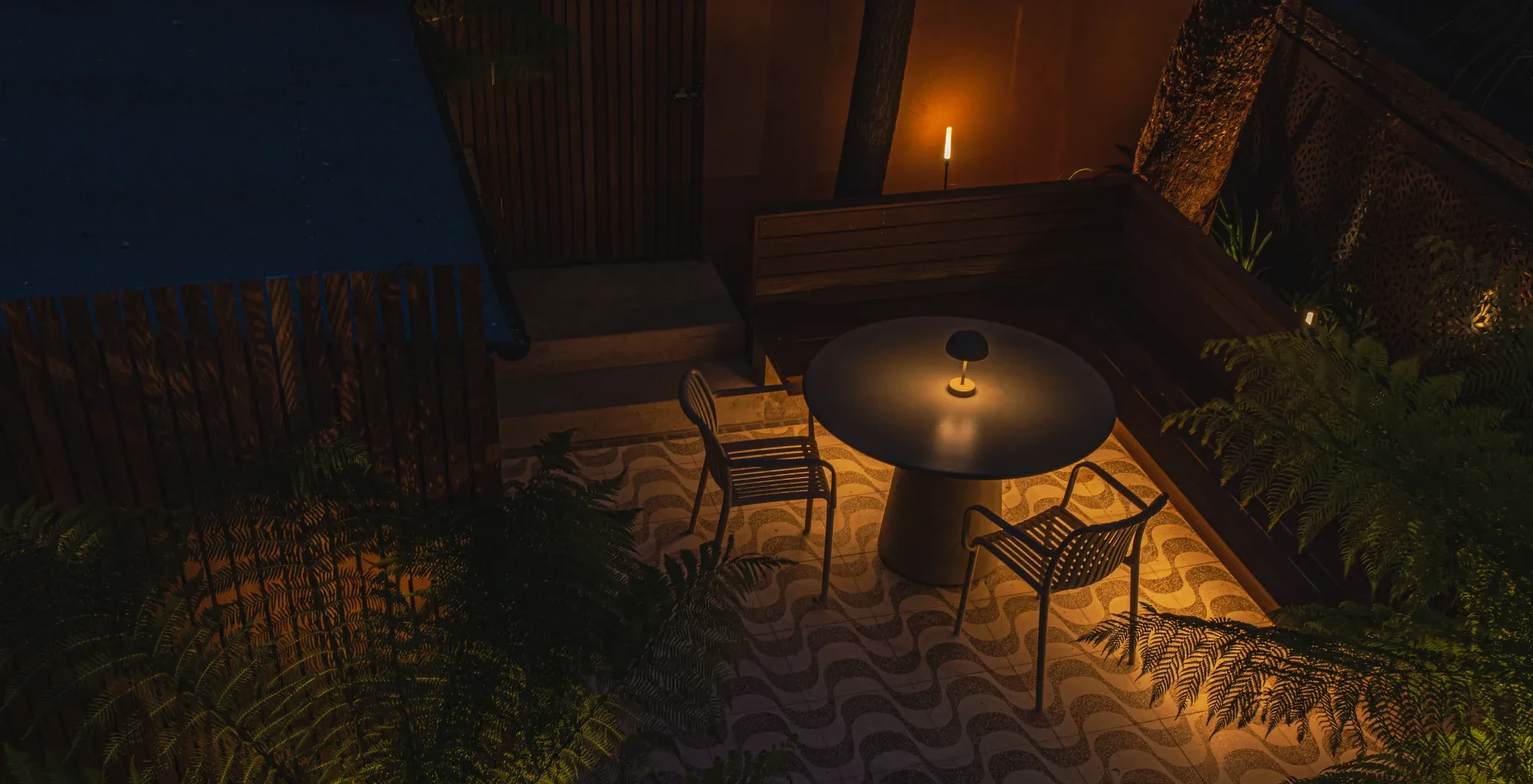
Bringing your garden to life after dark
The best garden lighting ideas are not really about lights at all. They are about the garden: the tree you love, the wall that glows in the evening sun, the path to the studio, the table where you eat on summer nights. Good lighting simply lets you enjoy those things for more of the day and more of the year.
The designers at Chelsea, the lighting studios that work with them and the principles set out by bodies such as the RHS and DarkSky International all point in the same direction. Light gently. Light what matters. Hide the source. Choose warm light. Leave room for darkness. And think about the view from inside as much as the garden itself.
If you would like to explore what your garden could look like at night, we would love to help. We work across Sussex, Surrey, Kent and South West London, and every project begins with a conversation, ideally in your garden as the light fades. You can book a lighting consultation at toddrobertslighting.co.uk/contact.
References
[1] RHS, “Seven take-home design trends at RHS Chelsea Flower Show 2024”. Royal Horticultural Society. https://www.rhs.org.uk/shows-events/rhs-chelsea-flower-show/news/2024/take-home-design-trends
[2] RHS, “Design ideas to inspire you from RHS Chelsea Flower Show 2025”. Royal Horticultural Society. https://www.rhs.org.uk/shows-events/rhs-chelsea-flower-show/news/2025/chelsea-design-ideas
[3] “Illuminating Chelsea Flower Show 2024”. John Cullen Lighting. https://www.johncullenlighting.com/illuminating-chelsea-flower-show-2024
[4] “Shining a light on Chelsea Flower Show 2023”. John Cullen Lighting. https://www.johncullenlighting.com/shining-a-light-on-chelsea-flower-show-2023/
[5] “Lighting sculptures at RHS Chelsea Flower Show”. John Cullen Lighting. https://www.johncullenlighting.com/lighting_sculptures_at_rhs_chelsea_flower_show
[6] “Expert Outdoor Lighting Guide”. John Cullen Lighting. https://www.johncullenlighting.com/lighting-tips/garden-lighting-ideas/
[7] “Lighting Design Trends 2025”. John Cullen Lighting. https://www.johncullenlighting.com/lighting_trends_2025
[8] “The 5 outdoor lighting trends experts predict will rule in 2026”. Livingetc. https://www.livingetc.com/ideas/outdoor-lighting-trends-for-2026
[9] “Lighting trends for the garden in 2026”. Architect Projects (with Lights.co.uk). https://architectprojects.co.uk/lighting-trends-for-the-garden-in-2026/
[10] “Garden lighting trends 2025”. Homes and Gardens. https://www.homesandgardens.com/gardens/garden-lighting-trends
[11] “RHS Chelsea Flower Show 2026: inspiration beyond the gardens”. Elle Decoration. https://www.elledecoration.co.uk/design/events/a71349705/rhs-chelsea-flower-show-2026/
[12] “Five principles for responsible outdoor lighting”. DarkSky International. https://darksky.org/resources/guides-and-how-tos/lighting-principles/
[13] RHS, “How to light your garden without disturbing wildlife”. Royal Horticultural Society. https://www.rhs.org.uk/garden-design/how-to-light-your-garden
[14] Bat Conservation Trust and Institution of Lighting Professionals, Guidance Note GN08/23 “Bats and artificial lighting at night”. https://www.bats.org.uk/news/2023/08/bats-and-artificial-lighting-at-night-ilp-guidance-note-update-released and https://theilp.org.uk/gn08-bats-and-artificial-lighting-at-night/
[15] Institution of Lighting Professionals, Guidance Note GN01/21 “The reduction of obtrusive light”. https://theilp.org.uk/resource/gn01-ilp-guidance-note-1-the-reduction-of-obtrusive-light-2021.html
[16] Clean Neighbourhoods and Environment Act 2005, section 102. legislation.gov.uk. https://www.legislation.gov.uk/ukpga/2005/16/section/102 ; and West Lindsey District Council, “Statutory nuisance: lighting”. https://www.west-lindsey.gov.uk/environment-climate/environment/pollution-control/statutory-nuisance-lighting
[17] CPRE, “Only one in 20 of us can enjoy a starry sky: Star Count results”. CPRE, The Countryside Charity. https://www.cpre.org.uk/news/only-one-in-20-of-us-can-enjoy-a-starry-sky-star-count-results-find/
[18] HomeOwners Alliance, “Top 10 kerb appeal features”. https://hoa.org.uk/advice/guides-for-homeowners/for-owners/kerb-appeal/
[19] NICEIC, “Gardens and electrics: what you need to know”. https://niceic.com/householders/gardens-and-electrics-what-you-need-to-know/
[20] Todd Roberts Lighting, “Case studies” (Moroccan Courtyard, Brighton; Tiered Courtyard, Lyndhurst Road, Brighton). https://www.toddrobertslighting.co.uk/case-studies

Comments